
Kosher Food at Bryant Park Winter Village: Babka Bailout in New York City

Updated: Mar 29
New York City's Bryant Park Winter Village ✈

There are certain places in New York City that take on a completely different identity once winter arrives, and Bryant Park Winter Village is one of them. Tucked into Midtown Manhattan, just behind the main branch of the New York Public Library, Bryant Park transforms each year into a seasonal destination that draws both locals and visitors looking to experience the city during the colder months. The Winter Village typically runs from late October through early January, giving it a long window where the energy of the holidays gradually builds, peaks, and then gently winds down as the new year begins.
Book a Tour: Top New York City Tours

“For travelers planning a trip to New York City during the winter months, Bryant Park’s Winter Village remains one of the easiest places to incorporate into an itinerary. It does not require advance planning, it is centrally located, and it offers a mix of activities that can fit into almost any schedule.”

Walking into the park during this time feels like stepping into a temporary world layered over the familiar grid of Manhattan. The skyline still surrounds you, traffic still hums along Sixth Avenue, and office buildings loom overhead, but inside the park, everything softens. Wooden stalls line the pathways, lights hang overhead, and the centerpiece ice-skating rink pulls people toward it from every direction. Skaters circle the ice at different speeds, some gliding confidently while others hold onto the rail, and the sound of blades cutting across the surface blends with music and conversation.
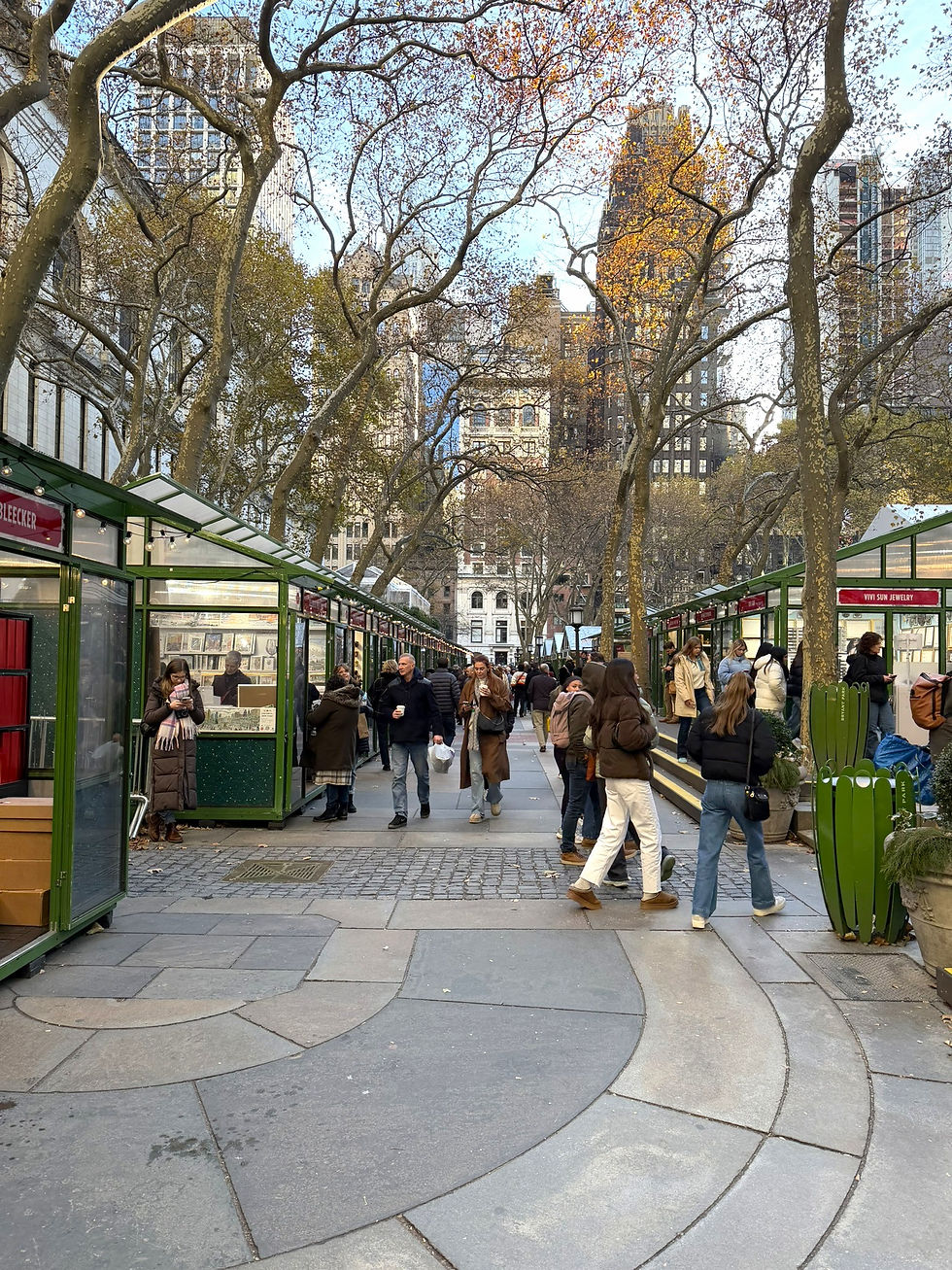
The layout encourages wandering. There is no single path to follow, no required route, just a natural flow that guides you from one section to another. Shops selling crafts, winter accessories, and seasonal gifts sit beside food stalls that send the smell of baked goods and warm drinks into the cold air. Even if you arrive without a plan, it doesn’t take long to settle into a rhythm of browsing, pausing, and moving again.

For those who keep kosher, finding food at large public markets can sometimes require planning ahead. Holiday markets especially can be unpredictable, with vendors changing from year to year and few clearly labeled options. That is part of what makes coming across a place like Babka Bailout feel significant, not only as a food stop but as a reliable option within an otherwise general market environment.
Babka Bailout operates out of Jersey City, just across the Hudson River, but during the Winter Village season they bring their bakery into Manhattan with a pop-up booth inside the park. Their location is along the row of food vendors near the skating rink, an ideal placement that keeps them in constant view of passing foot traffic. It is the kind of spot you might notice first because of the line forming in front of it, or because of the display of baked goods that immediately signals something different from the surrounding stalls.

The setup is compact, as all Winter Village booths are, but it manages to present a full menu within a small footprint. Behind the counter, trays of babka sit ready to be sliced, while other items are prepared to order. The pace is steady. People approach, scan the menu, place an order, and step aside as the next group moves forward. Even in colder weather, the demand doesn’t seem to slow down.

Babka itself carries a long history, rooted in Eastern European Jewish baking traditions, but here it is presented in a way that feels current and accessible. Instead of limiting the menu to classic chocolate or cinnamon, Babka Bailout leans into a broader range of flavors, combining traditional techniques with more modern combinations. The result is something that appeals both to those familiar with babka and to those trying it for the first time.
At the same time, the menu does not focus only on sweets. Savory options play an equally important role, particularly the burekas, which are a natural fit for a cold outdoor setting. Served warm, with a golden exterior topped in sesame seeds, they offer something more substantial than a pastry alone. The addition of dips and sides turns them into a complete snack or light meal, something you can hold in your hands while continuing to walk through the market.

On this visit, the choice was a potato bureka box paired with a hot chocolate. It is the kind of combination that feels especially fitting in this environment. The warmth of the food contrasts with the cold air, and the simplicity of the meal matches the casual nature of the setting. You can find a nearby table to sit or you can stand nearby, find a ledge, or simply keep moving as you eat.

The hot chocolate, topped with whipped cream and sprinkles, adds another layer to the experience. It is less about complexity and more about comfort, something warm to hold as much as something to drink. In a place like the Winter Village, that matters. The temperature, the crowds, and the constant movement all make warm drinks feel like part of the environment rather than just another menu item.
Beyond the food itself, what makes Babka Bailout notable is the role it plays within the larger context of the market. It serves a specific need without isolating itself from the broader experience. People who keep kosher can stop here and know they have an option, while others can approach it simply as another appealing booth among many. There is no separation, no distinct section of the market set aside for certain dietary needs. Everything exists together, which is part of what makes the Winter Village feel inclusive.

That sense of inclusion extends to the market as a whole. Even for visitors who are not looking for kosher food, Babka Bailout fits naturally into the experience. It becomes one more stop along the path, one more place to try something different. In a setting where variety is part of the appeal, that integration matters.

As the day shifts into evening, the atmosphere changes again. Lights become more noticeable, reflections from the rink grow stronger, and the park takes on a quieter tone even as the number of visitors remains high. The contrast between the surrounding city and the enclosed space of the market becomes more pronounced. Office buildings light up above, while inside the park, the focus stays on the smaller details: the glow from the booths, the movement of skaters, and the steady rhythm of people passing through.
The Winter Village is not a hidden gem. It is well known, frequently visited, and often crowded. But that is part of its identity. It is not trying to be exclusive or hard to find. Instead, it functions as a shared space where different kinds of visitors can have different experiences at the same time. Some come to skate, others to shop, others simply to walk through and take in the scene.

For someone documenting places through travel content, it offers a balance between visual appeal and practical usefulness. The visuals are clear. The rink, the stalls, the lights, and the surrounding skyline all come together in a way that translates easily to video and photography. At the same time, there is real information to share, whether that is where to find certain foods, how the market is laid out, or when it is open.
Timing a visit can make a difference. Earlier in the day tends to be less crowded, allowing for a more relaxed walk through the stalls. Evenings bring a stronger atmosphere but also more people. Weekends can feel especially busy, while weekdays offer a bit more space to move. The season itself also matters. Visiting closer to the beginning or end of the Winter Village run can provide a slightly different experience compared to the peak weeks leading up to the holidays.
What remains consistent throughout is the structure of the market. The booths stay in place, the rink continues to operate, and the general layout does not change dramatically. That consistency makes it easier to return, knowing what to expect while still finding something new each time.

Leaving the park, the transition back into the city is immediate. The lights of the Winter Village fade behind you, replaced by traffic, storefronts, and the pace of Midtown. But the experience lingers in a different way. It is not about a single highlight or a single moment, but about the combination of elements that come together over the course of a visit.

For travelers planning a trip to New York City during the winter months, Bryant Park’s Winter Village remains one of the easiest places to incorporate into an itinerary. It does not require advance planning, it is centrally located, and it offers a mix of activities that can fit into almost any schedule. Whether you are stopping by for a short walk, spending time on the ice, or seeking out specific food options like Babka Bailout, the experience adapts to the time you have.
In a city that is constantly changing, there is something reassuring about a place that returns each year with a familiar structure. The Winter Village may shift slightly from season to season, but its core identity remains the same. It is a temporary space that feels established, a seasonal destination that becomes part of the city’s rhythm.
And within that rhythm, small details matter. A warm bureka on a cold day, a cup of hot chocolate held between gloved hands, the sound of skates moving across ice, and the steady flow of people moving through the park all come together to define the experience. Babka Bailout becomes one of those details, a specific stop within a larger setting, adding both flavor and function to a place that already has plenty of both.
Book a Tour: Top New York City Tours


Comments